Productivity
Learning
How Fast Should I Listen To Audiobooks?
Choose the right speed for audiobooks to boost learning and enjoyment. Faster than 1x works with the right approach and gradual adjustment.
By Rupert GoughPublished
Key takeaways
- Most audiobooks are 10-11 hours at standard speed; educational books are often 5-8 hours
- Fact-based and self-help books suit faster speeds (1.5x-2x); fiction benefits from slower, nuanced listening
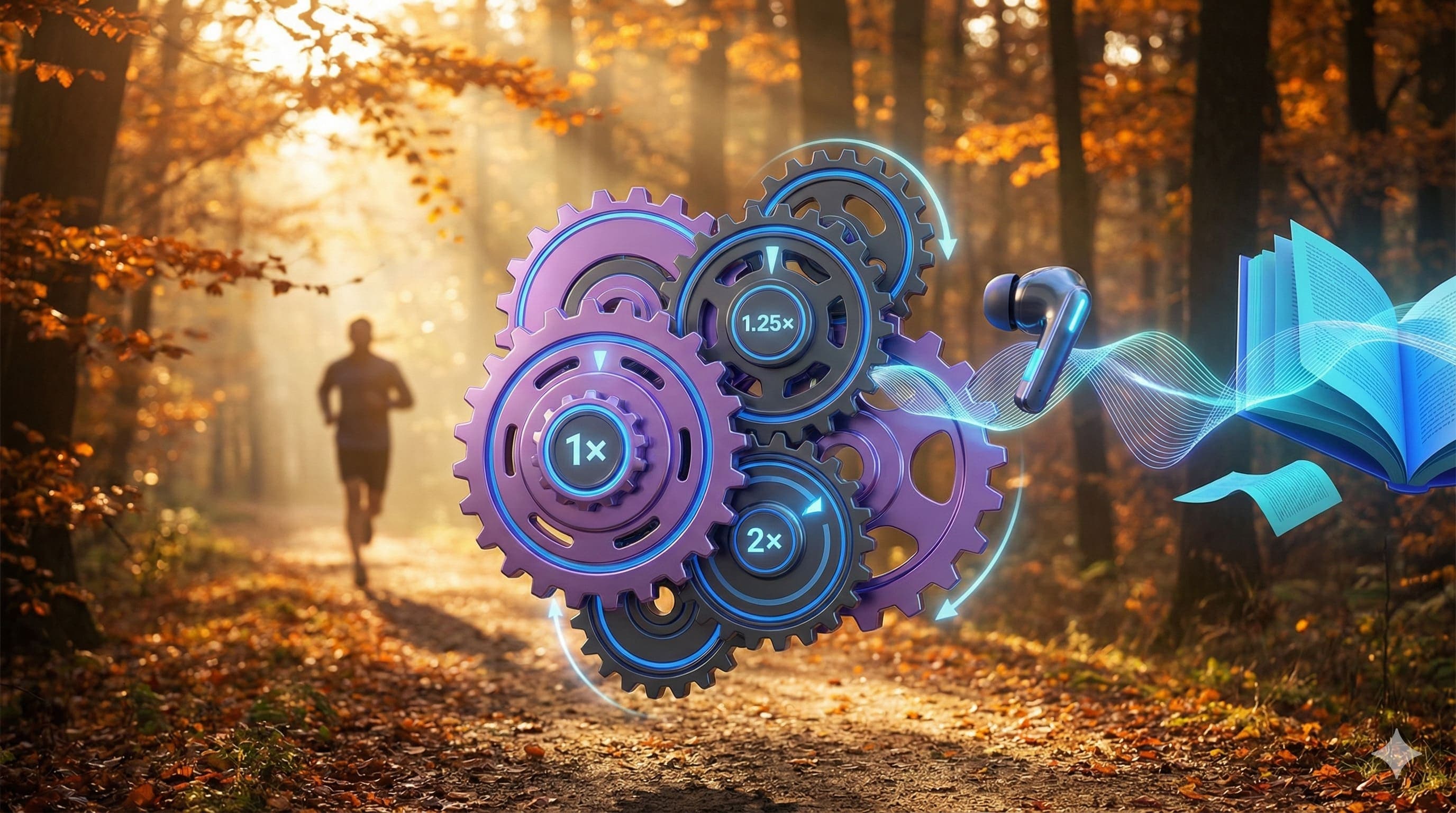
- Start with 1.25x or 1.5x before jumping to 2x - your brain adapts better with gradual increases
- Going above 2x speed typically leads to diminishing returns in comprehension and enjoyment
- Match speed to purpose: faster for learning and review, slower for enjoyment and appreciation
Audiobooks are powerful productivity tools. You can listen in the car, on walks, at the gym - anywhere you have audio. Even 20 minutes a day of listening adds up significantly over time. Listening lets you learn while doing other things, something you can't do with a paper book. Research indicates retention isn't significantly lower when listening versus reading.
Many highly productive people don't stick to listening at standard 1× speed. They speed up to soak up more information in less time - while still following the content.
How Long Is an Average Audiobook? #
- Most audiobooks are around 100,000 words, which typically works out to about 10 - 11 hours of listening at standard narration speed.
- Educational or self-help books tend to be shorter, often 5 - 8 hours long.
What Speeds Do People Use? #
- Many listeners stay very close to 1× speed, but some try faster playback. One survey suggests a modest portion of users have experimented with 1.5× or higher.
- At 1.5× speed, a 6-hour book can be completed in around 4 hours. This saves time, but voice tone, pacing, and pauses can feel altered.
- The standard narration pace is usually in the range of 150-160 words per minute, which balances clarity and flow.
Which Books Suit Faster Listening? #
Not all books are equally suited for accelerated listening. Here are some guidelines:
- Fiction / narrative works often include descriptive language, emotional tone, pauses. Listening too fast may cause you to miss nuance, character voices or tone.
- Fact-based / educational / self-help books are often more straightforward. If your goal is to extract key ideas rather than savour prose, faster speeds (1.5× to 2×) may work well.
- For books that require deep understanding (complex theory, technical detail, dense philosophy), slower speeds or standard pace may serve better.
How Fast Is Too Fast? #
- Going above 2× speed often leads to diminishing returns in retention. Speech tends to sound unnatural, and comprehension may suffer.
- Some people can push to 3× for short bursts or review, but this often comes at the cost of enjoyment or deep absorption.
- Whether the voice is familiar (or very distinctive) can also make a difference - recognisable voices sped up tend to seem odd or harder to listen to.
Tips to Transition to Faster Listening #
If you'd like to try speeding up your listening, here are ways to do it without losing comprehension:
- Start with something easy / low-stakes. A topic you're already familiar with or a book that you care less deeply about.
- Choose a moderate step first, such as 1.25× or 1.5×, before jumping to 2× or beyond.
- Always set the speed before you begin listening, rather than switching mid-book. Your brain adjusts better when it stays consistent.
- Listen while doing another task, like commuting or walking. You can afford a bit of drift in comprehension, and you'll adapt.
- Use good audio equipment - noise between you and your ears matters. Clear headphones or earbuds and minimal background noise help.
- Assess retention - after you finish, pause and reflect on how much you remember. If you've missed too much, dial the speed back.
Finding Your Ideal Listening Speed #
Here are some personal experiments you can try to discover what speed works best for you:
- For books read for pleasure, try 1.25× to 1.5× and see whether you still enjoy the flow.
- For information-dense or reference-style books, try 1.75× or 2×, but take notes or pause often.
- Periodically try a chapter at 1× to compare how much more you appreciate tone, pauses, characterisation or nuance.
- Over time, your "comfortable fast speed" may shift upward, especially if you regularly practise faster listening.
Why It Matters #
Adjusting how fast you listen isn't about racing through books - it's about aligning speed with purpose. If your goal is learning, idea exposure or review, faster speeds can multiply your output. If your goal is enjoyment, relaxation or literary appreciation, slower speeds preserve texture and tone.
By choosing speed deliberately - and adjusting depending on content - you can listen more efficiently without sacrificing what you get out of the book. For more ideas on optimising how you work, see our quick ways to boost productivity and efficiency. As you gain experience, the right speed will become intuitive and every listening session becomes more satisfying.
LD decision lens
Admin Waste Audit
Find repeated admin before designing a system
Use this when time is disappearing into data entry, chasing, duplicate work, rework, email threads, or manual reporting.
- Finding where admin time and attention are being wasted
- Prioritising the bottleneck before automating around it
- Building a business case for process or software work
Useful tools
Turn this idea into a next step
These free tools help you put rough numbers, priorities, or workflow shape around the problem before choosing software.
Eisenhower Matrix
Sort work by urgency and importance so the next action is clearer before adding process or software.
Open toolPomodoro Timer
Use focused work sprints when the problem is attention, momentum, or context switching rather than software.
Open toolTyping Speed Test
Check whether keyboard speed is a small but measurable productivity constraint in daily admin work.
Open toolQuick Questions
What speed should I listen to audiobooks at?
It depends on the content and your goal. For fact-based or self-help books where you want to extract key ideas, 1.5x-2x works well. For fiction or narrative works where tone and character voices matter, stay closer to 1x. Start with 1.25x-1.5x and adjust based on comprehension.
How long is the average audiobook?
Most audiobooks are around 100,000 words, which works out to about 10-11 hours at standard narration speed (150-160 words per minute). Educational and self-help books tend to be shorter, often 5-8 hours.
Is listening at faster speeds bad for retention?
Not necessarily for speeds up to 2x, especially for straightforward content. Research indicates retention isn't significantly lower when listening versus reading. However, going above 2x often leads to diminishing returns, with speech sounding unnatural and comprehension suffering.
How do I transition to faster audiobook listening?
Start with familiar topics or low-stakes content. Choose a moderate step first (1.25x-1.5x) before jumping higher. Set speed before starting rather than mid-book. Listen during tasks like commuting. Assess your retention afterward and dial back if needed.
Strategy next step
Turn the idea into a roadmap
If the article matches a problem in your business, start with a practical AI or technology roadmap before spending money on tools or development.
Other articles worth reading
AI & Automation
ChatGPT for NZ Small Business: A Practical Guide to Saving 5+ Hours a Week
ChatGPT isn't just for tech companies. Here's how NZ small business owners are using it to cut admin, write faster, and get more done.

Productivity
10 Quick Ways to Improve Productivity and Efficiency
Bite‑sized actions you can take right now to do more and do it better - improve both productivity and efficiency with simple, practical changes.

Productivity
Understanding the Difference: Productivity vs Efficiency and How to Improve Both
Productivity measures what you accomplish; efficiency measures how well you use resources. Discover strategies to improve both.