← Back to Articles
Custom Software
Industry Guides

Custom Software for NZ Trades and Construction Businesses: Quoting, Jobs, H&S, and Invoicing

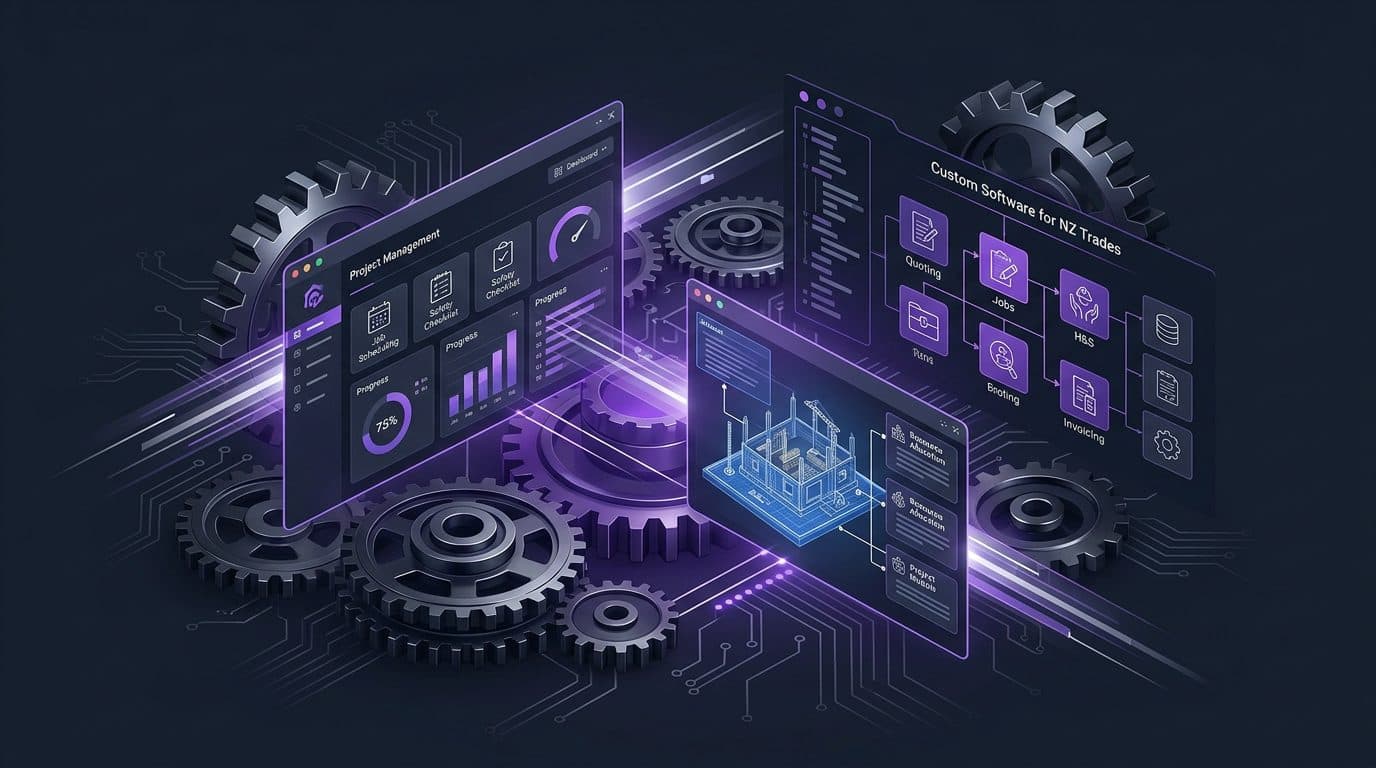
Running a trades or construction business on paper and text messages is costing you money. Here's what custom job management software can actually look like for a NZ trades business.

Custom Software for NZ Trades and Construction Businesses: Quoting, Jobs, H&S, and Invoicing
#trades software NZ#construction software NZ#job management NZ#H&S software NZ#quoting software trades#field service management

Key Takeaways

  • 1Custom job management software connects quoting, job scheduling, field staff, H&S compliance, and invoicing in one system — replacing the spreadsheets, texts, and paper that cost trades businesses time and margin.
  • 2NZ's Health and Safety at Work Act 2015 places significant obligations on PCBUs — custom H&S modules turn compliance from a filing exercise into a live, site-by-site safety system.
  • 3Subcontractor management — including licence verification and insurance tracking — is a direct liability issue for NZ trades businesses, particularly those engaged in licensed building work or electrical and gas work.
  • 4Quote-to-job conversion, materials tracking, and progress invoicing mean your actual job costs are visible in real time — not discovered weeks later when the invoice arrives.
  • 5Xero integration keeps your job management system and your accounts aligned without double-entry, giving you accurate job profitability data that generic accounting software alone can't provide.

Most NZ trades businesses are run by people who are genuinely skilled at their trade. Whether you're a Licensed Building Practitioner building residential homes in Tauranga, an electrical contractor handling commercial fitouts in Auckland, or a plumbing and gasfitting business working across the Bay of Plenty — the technical capability is there. What often isn't there is a business system that keeps up with how the work actually runs.

The typical picture looks something like this: quotes go out as PDFs from a template. Accepted jobs get added to a whiteboard or spreadsheet. Field staff get called or texted. H&S records live in a folder somewhere — updated when the auditor is coming. Subcontractor invoices arrive and you're not entirely sure which job they're for. Invoicing happens when someone remembers to do it. And at the end of the month, you're not entirely sure which jobs made money and which didn't.

This isn't a criticism — it's how most trades businesses operate, because the tools available either don't fit the way construction work runs, or they require a full-time administrator to maintain. Custom job management software changes that by building a system around the way your business actually works. Here's what each piece looks like.

Job and Project Management: One Record From Start to Finish

The foundation of any trades business system is the job record — a single source of truth that covers everything from the initial scope through to final sign-off. Custom software creates that record the moment a quote is accepted, pulling through the scope, customer details, and site address automatically.

From there, the job is broken into tasks or phases. Each task gets assigned to a staff member or subcontractor, with start and completion dates. As work progresses, staff update their task status from the field — no separate timesheet systems, no end-of-day call to the office to report progress. The project manager has a live view of where every job stands at any given moment.

Job completion triggers a sign-off workflow. For building work, this might include a checklist of items that must be confirmed complete, photos of the finished work, and customer acknowledgment. For businesses working under the Building Act 2004, completion documentation requirements are built into the workflow — not an afterthought.

For larger construction projects with multiple stages, the system supports milestone-based management. Each milestone has its own tasks, its own completion criteria, and links to the progress invoicing schedule. The relationship between physical completion on site and invoicing milestones is visible and enforced — rather than relying on the project manager to remember when the next invoice can go out.

Quoting: Professional, Profitable, and Trackable

Quoting is where margin is made or lost in most trades businesses, and it's often the least systematised part of the operation. Labour rates estimated from memory, material markups applied inconsistently, overhead and margin forgotten entirely. A custom quoting system brings structure to what is often an ad hoc process.

Quotes are built from a library of standard line items — labour rates, common materials, subcontract allowances — with unit costs and markup rules pre-set. Building a quote means selecting and configuring items, not starting from a blank page. Material costs are current (either manually maintained or pulled from supplier integrations), and markup percentages are applied consistently. The finished quote presents as a professional PDF with your branding, a clear breakdown, and your terms and conditions included.

Quote acceptance is handled through a link sent to the customer. They review the quote, e-sign it, and it converts to an active job automatically. No printing, no scanning, no manual job creation. For businesses where quote turnaround speed is a competitive advantage — particularly in residential work where customers are comparing multiple quotes — this matters.

Quote tracking is the part most businesses miss. Which quotes are outstanding? Which have been pending for more than two weeks without a response? Custom software gives you a pipeline view of outstanding quotes with follow-up flags — so you're not leaving accepted work on the table because someone forgot to follow up.

Field Staff Portal: The Site-to-Office Connection

Field staff are where the work happens, but they're also the hardest part of the business to keep connected to the office system. Phone calls and text messages are unreliable. Paper timesheets arrive Friday afternoon with questionable accuracy. Site photos exist on four different people's phones and no one can find the before photo when the client queries the invoice.

A mobile-optimised field staff portal solves this without requiring your team to become technology enthusiasts. It's built to work on a phone, with a simple interface that shows each person their jobs for the day, what tasks they're assigned to, and what they need to do.

Time logging happens on-site — a tap to start the clock when they arrive, a tap to stop when they leave. Break time, travel time, and task-specific time can all be logged separately. That data feeds directly into job cost tracking and, if integrated, into payroll. The Holidays Act 2003 compliance issues that have cost NZ employers hundreds of millions in back-pay stem partly from inaccurate time records — a system that captures time accurately protects you as much as it helps with job costing.

Materials used on site are logged against the job — either from the van stock, a supplier delivery, or a trip to the trade counter. This creates a running tally of material costs that can be compared against the quoted material allowance in real time. When a job starts running over on materials, you know during the job rather than after the invoice.

Photo upload is one of the simplest and most valuable field features. Before and after photos of every job, tagged to the job record, accessible to the office immediately. For damage disputes, insurance claims, or warranty queries, those photos are the record. For Master Builders or Registered Master Electricians with quality assurance requirements, photo documentation is part of the standard.

Health and Safety Compliance: HSWA 2015 in Practice

The Health and Safety at Work Act 2015 (HSWA) fundamentally changed H&S obligations for NZ businesses. PCBUs — Persons Conducting a Business or Undertaking — have a primary duty to ensure the health and safety of workers and others affected by their work, so far as is reasonably practicable. For trades and construction businesses, this obligation is substantial, because the work environments are inherently hazardous.

WorkSafe NZ is the primary regulator, and it investigates incidents, conducts audits, and can issue improvement notices, prohibition notices, and prosecutions. The test in any investigation is whether the PCBU took all reasonably practicable steps. Having documented H&S processes — and evidence that they were followed — is the foundation of that defence.

Custom H&S software turns compliance from a filing exercise into a live operational system. Every site gets its own hazard register — identified hazards, their severity rating, and the controls in place. Hazard registers are created when a job is set up and updated as site conditions change. They're accessible from the field, so workers arriving on site can review current hazards before starting work.

Toolbox meetings are logged in the system — date, attendees, topics covered, any issues raised. This creates the documented record that demonstrates your team is engaged in regular safety communication, not just filing a policy document. Toolbox topics can be scheduled and prompted by the system, so the responsibility for H&S communication doesn't fall entirely on the memory of whoever runs the site.

Incident and near-miss reporting is built into the field portal. Workers can log an incident immediately on their phone — what happened, where, who was involved, and photos if relevant. The report triggers a notification to the relevant manager and is stored against the site record. For notifiable events under HSWA — incidents that must be reported to WorkSafe — the system generates the required documentation and ensures it's reviewed promptly.

PPE records, induction records for new workers, and subcontractor induction tracking complete the H&S picture. Every person who sets foot on your site has a record of their induction, their PPE allocation, and any site-specific training. If WorkSafe comes to inspect or investigate, that documentation is available immediately — not scattered across email and paper forms.

Subcontractor Management: Licences, Insurance, and Accountability

Most trades businesses use subcontractors regularly — and the liability that comes with subcontractor management is often underestimated. Under HSWA, a PCBU has obligations in relation to workers, which in certain circumstances can include subcontractors and their workers on your sites. Beyond H&S, using an unlicensed subcontractor for licensed building work, electrical work, or gasfitting carries direct regulatory and financial risk.

Custom subcontractor management maintains a database of every subcontractor your business uses. Each record holds their trade licence details — LBP licence type and number, Electrical Inspector authorisation, registration with the NZ Plumbers Gasfitters and Drainlayers Board — along with their public liability insurance details, employer liability cover, and any other relevant certifications.

Expiry tracking is where this delivers operational value. Licences and insurance policies expire. Without a system, you find out after the fact — when a subcontractor is already on site or a policy has lapsed without renewal. Custom software flags every approaching expiry — 60 days out, 30 days out, 7 days out — so you have time to act. A subcontractor whose licence or insurance has lapsed can be flagged as inactive and blocked from being assigned to new jobs until the documentation is renewed.

Payment management for subcontractors — purchase orders, invoice matching, approval workflow — sits alongside the compliance tracking. When a subcontractor invoices for work, the invoice is matched to the purchase order and the job record. Payment is approved when the work is confirmed complete and the documentation is in order. The Construction Contracts Act 2002 governs payment obligations for construction contracts in NZ — payment terms, payment schedules, and dispute resolution. Custom software can reflect your contractual obligations to subcontractors and ensure payments are processed on time.

Materials and Purchasing: Knowing What a Job Actually Costs

Material costs are one of the biggest sources of margin erosion in construction. Materials are ordered, over-ordered, left on site, returned, lost, or used on the wrong job. By the time the supplier invoice arrives, connecting it to the right job is a detective exercise.

A custom purchasing workflow starts with a purchase order — raised against a specific job, with the materials and quantities from the original quote as a baseline. When the supplier delivers, the delivery is receipted against the purchase order. When the supplier invoice arrives, it's matched to the purchase order. Any variances — different quantities, different prices — are flagged for review rather than quietly absorbed.

Job cost tracking gives you the running picture: materials quoted versus materials ordered versus materials invoiced. Labour hours quoted versus hours logged. Subcontract allowances versus subcontract purchase orders. At any point in a job's life, you can see whether you're on budget or tracking over — and by how much. That visibility changes how project managers make decisions on site, because the consequences of those decisions become visible in real time rather than at month-end.

Invoicing: Getting Paid Without the Chase

Getting the work done and getting paid for it are two different things, and many trades businesses are better at the former than the latter. Progress billing, milestone invoicing, and retention management are all areas where manual processes create unnecessary delays and disputes.

Custom invoicing generates invoices automatically at the trigger points you define — job completion, milestone achieved, deposit due, progress claim submitted. The invoice is populated from the job record: the right customer, the right job reference, the right scope of work completed, the right amount. Sent to the customer immediately, with payment terms clearly stated.

For larger projects, retention is tracked within the system. Retention withheld at each progress claim is accumulated against the project and released at practical completion (and defects liability expiry) according to the contract terms. Retention amounts that should have been released — but haven't been — are flagged. Chasing retention is one of the most time-consuming parts of construction project management; a system that tracks it automatically reduces the mental load significantly.

Xero integration means invoices raised in the job management system flow through to your accounts automatically. Payments received in Xero are reconciled back. You don't maintain two sets of records, and your accountant gets accurate job-level profitability data that pure Xero reporting can't provide. For trades businesses exploring membership with NZIA (New Zealand Institute of Architects — for architectural work), Master Builders, or Registered Master Electricians, accurate financial records and documented project histories are often part of the membership and quality assurance requirements.

Why Off-the-Shelf Job Management Software Often Falls Short

Generic field service management software exists, and some of it is genuinely useful. But trades businesses have specific requirements that generic tools often compromise on: NZ-specific H&S compliance structures, the LBP licensing framework, the NZ Plumbers Gasfitters and Drainlayers Board registration requirements, Construction Contracts Act payment terms, and integration with NZ-native tools like Xero.

Beyond the NZ context, the real issue is workflow fit. Off-the-shelf tools are built for the average business in the average sector. Your business has specific ways of quoting, specific subcontractor relationships, specific H&S requirements based on the work types you do, and specific reporting requirements for your clients. A custom system is built around those specifics — not adapted from something built for HVAC contractors in Ohio.

Where to Start

For most trades businesses, the starting point is wherever the pain is most visible. If quoting is ad hoc and you're losing work or margin because of it, start there. If H&S compliance is a liability you're not managing systematically, start there. If job costing is invisible until month-end, that's the place.

The right approach is to build a focused system that solves the highest-priority problem well, then extend it to connected areas. A quoting system naturally extends to job management. Job management naturally extends to field staff and timesheets. H&S compliance naturally extends to subcontractor management. Each module reinforces the others, and by the time you have the full system, it reflects how your business actually runs — not a template that you've had to work around.

If you're a NZ trades or construction business looking at the gap between how your business runs today and how it could run with better systems, the conversation starts with what's costing you the most time and margin right now. That's usually a short list — and it's the right place to start building.

Quick Questions

We already use Xero and a spreadsheet — why would we need custom software?

Xero handles your accounts well, but it doesn't manage jobs, schedules, field staff, H&S records, or subcontractor compliance. Spreadsheets fill the gap but break down as the business grows — they can't be updated in the field, don't enforce workflows, and aren't auditable. Custom job management software handles everything Xero doesn't, then feeds the financial data back into Xero automatically.

How does the H&S module handle WorkSafe NZ reporting obligations?

The system maintains site hazard registers, toolbox meeting records, incident logs, and near-miss reports. For notifiable events under the Health and Safety at Work Act 2015, the system generates the documentation required for WorkSafe NZ notification and stores it against the site record. It doesn't replace your obligation to notify WorkSafe directly, but it ensures the paperwork is complete and auditable.

Can the system track Licensed Building Practitioner requirements?

Yes. Each staff member and subcontractor can have their licence type, registration number, and expiry date stored in the system. The system alerts you when licences are approaching expiry. For Licensed Building Work, the system can track which LBP completed which work, generating the record-keeping trail required under the Building Act 2004.

What's the typical ROI for a trades business investing in custom job management software?

The biggest returns typically come from three areas: recovered margin through accurate materials and time tracking (most businesses discover jobs are less profitable than they thought), reduced time chasing approvals and status updates (often 3–5 hours per week per project manager), and avoided compliance incidents. Businesses that previously lost money on jobs due to poor cost tracking often see the system pay for itself within 6–12 months.

Free Assessment

Discover Your Automation Potential

Take our 2-minute quiz to find out how much time and money you could save. Get personalised recommendations for your business.