
Efficiency
Automation
Mapping Your Business Processes: A Guide to Finding Automation Opportunities
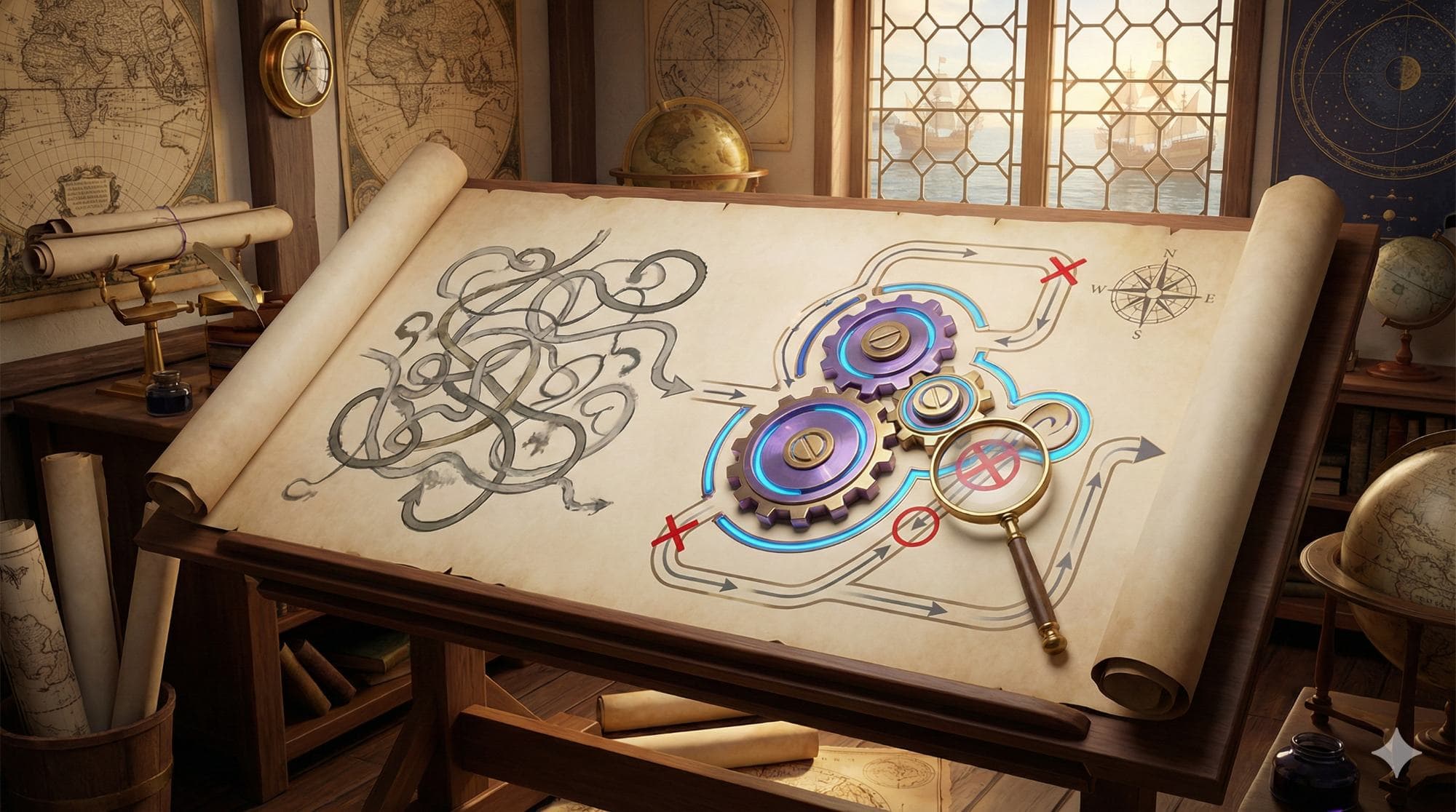
Turn invisible workflows into visible blueprints for growth. Map every action and decision to solve the right problems, not speed up bad habits.
Quick answer
Process mapping helps find automation opportunities by showing each step, decision, handoff, delay, exception, and owner in a workflow. Once the work is visible, it becomes easier to decide what to remove, standardise, automate, delegate, or measure.
- Map what actually happens.
- Look for delays and repeated decisions.
- Automate after the process is agreed.
Put your workflow questions into a broader roadmap that reflects your business goals and the resources available. Explore Tech Clarity.
Key takeaways
- Most business processes live in staff members' heads as tribal knowledge -invisible, unmeasured, and impossible to improve until they're mapped visually
- Document the 'current state' without judgement first: a simple purchase approval often reveals five emails and three manual data entry points nobody knew about
- Bottlenecks are choke points where work stalls -an in-tray cleared weekly, a spreadsheet only one person understands -these determine your maximum operational speed
- Automating a mess yields a faster mess: before automating any step, ask whether that step needs to exist at all -often mapping reveals redundant reports and pointless data collection
- Clear process maps are prerequisites for AI deployment: you cannot tell AI to 'handle complaints' without defining successful resolution and escalation paths
Every business runs on a complex web of processes, habits, and unwritten rules that dictate how work gets done each day. For many SME owners, these processes live primarily in the heads of long-serving staff members rather than in documented systems. This reliance on tribal knowledge creates a significant risk where critical workflows are invisible, unmeasured, and impossible to improve. When you cannot see the steps your team takes to deliver a product or service, you cannot identify where time is being wasted or where value is leaking from your operation.
Process mapping is the strategic exercise of making these invisible currents visible. It involves capturing every action, decision point, and handover required to complete a specific business function, from the initial customer enquiry to the final invoice. By laying these steps out visually, you move away from assumptions about how your business runs and confront the reality of how it actually operates. This clarity is the essential first step before implementing any automation or AI solution, as it ensures you are solving the right problems rather than simply speeding up inefficient habits.
Visualising the Journey of Work #
The first stage of effective process mapping is to document the "current state" of your operations without judgement or immediate attempts to fix things. You must gather the people who actually do the work and ask them to walk through their daily tasks step-by-step. It is often surprising for business owners to discover just how many convoluted workarounds and manual checks have evolved over time to deal with legacy software limitations. This exercise often reveals that a simple task, like approving a purchase order, actually involves five different emails and three manual data entry points.
Once you have sketched out these workflows, often using a flowchart with "swimlanes" to represent different departments, the complexity of your operations becomes undeniable. You will likely see zigzagging lines where information bounces back and forth between the same two people multiple times. This visual representation highlights the friction points that are invisible during the daily grind. It allows you to see exactly where a document sits waiting for approval or where a staff member is forced to switch between three different screens to complete a single action.
Identifying the Bottlenecks and Friction #
With your map in hand, you can begin to identify the specific bottlenecks that are throttling your business efficiency. A bottleneck is any point in the process where the flow of work is impeded, causing a backlog to accumulate and delaying the final outcome. In a manual environment, these often look like an "in-tray" on a manager's desk that is only cleared once a week, or a complex spreadsheet that only one specific employee knows how to update. These choke points determine the maximum speed at which your entire business can operate. Our workflow mapping worksheet can help you systematically identify where your team loses time.
Automation is particularly effective at shattering these specific bottlenecks. If your map reveals that your sales process stalls while waiting for a manager to approve pricing, an automated workflow can be configured to auto-approve standard margins and only flag exceptions for human review. Similarly, if your production team is waiting for job sheets to be printed and walked down from the office, digital signage or tablet integration can deliver that information instantly. By targeting these specific friction points identified in your map, you ensure that your investment in technology delivers an immediate and tangible increase in throughput.
The Danger of Automating Bad Processes #
A common trap for eager business owners is the temptation to apply automation directly to their existing processes without first refining them. There is a saying in the industry that automating a mess simply yields a faster mess. If your current invoicing process is illogical and requires unnecessary checks, writing software to perform those illogical steps faster does not solve the root cause of the inefficiency. It merely cements a bad habit into code, making it harder to change in the future.
Process mapping forces you to ask "why" before you ask "how." Before you automate a step, you must determine if that step needs to exist at all. Often, the mapping process reveals that certain reports are generated but never read, or that data is collected that serves no downstream purpose. Eliminating these redundant steps is free and provides immediate efficiency gains even before you spend a dollar on software. True digital transformation happens when you use the insights from your map to redesign the workflow for simplicity, and then apply automation to power that streamlined ideal state.
Preparing for an AI-Driven Future #
As we move into an era where Artificial Intelligence can handle complex cognitive tasks, having clear process maps becomes even more critical. AI models require clear instructions and structured data to function effectively within a business context. You cannot simply tell an AI to "handle customer complaints" without defining what a successful resolution looks like and what the escalation paths are. Your process map provides the logic and the guardrails that allow these advanced tools to operate safely and effectively alongside your human team.
By defining your standard operating procedures now, you are building the infrastructure for future innovation. When you know exactly which inputs trigger which outputs, you can start to deploy AI agents to handle entire sections of your workflow autonomously. For instance, an AI could read incoming emails, classify them based on your mapped criteria, and draft responses or update your CRM without human intervention. This level of sophistication is only possible when the underlying business logic has been clearly charted and optimised.
Start Your Efficiency Journey #
The act of mapping your processes is one of the highest-value activities a business owner can undertake. It transforms your operations from a black box into a transparent engine that can be tuned, optimised, and scaled. It is also the essential first layer of the Efficiency Stack - without this foundation, standardisation and automation are built on guesswork. You do not need complex software to start; a whiteboard and an honest conversation with your team are enough to begin uncovering the hidden opportunities for growth.
For more on why your current systems may be costing you money, see our article on the hidden costs of disconnected data. To understand the business case for automation, read our guide on calculating ROI of automation.
A useful companion: Workflow Mapping Worksheet.
Quick Questions
What is process mapping?
Process mapping captures every action, decision point, and handover required to complete a business function -from initial enquiry to final invoice. It makes invisible workflows visible, moving from assumptions about how your business runs to confronting how it actually operates.
How do I start mapping my business processes?
Gather the people who actually do the work and ask them to walk through tasks step-by-step without judgement. Use flowcharts with 'swimlanes' for different departments. Often you'll discover that simple tasks like purchase approval involve five emails and three manual data entry points.
What are bottlenecks in business processes?
Bottlenecks are points where work flow is impeded, causing backlogs. They look like an in-tray cleared once weekly, or a spreadsheet only one employee can update. These choke points determine the maximum speed at which your entire business can operate.
Why shouldn't I just automate my current processes?
Automating a mess yields a faster mess. If your invoicing process has unnecessary checks, automating those illogical steps cements bad habits in code. Process mapping forces you to ask 'why' before 'how' -often revealing reports that are never read or data collected for no purpose.
How does process mapping prepare a business for AI?
AI requires clear instructions and structured data. You cannot tell AI to 'handle complaints' without defining successful resolution and escalation paths. Process maps provide the logic and guardrails allowing AI to operate safely. When you know which inputs trigger which outputs, AI can handle entire workflow sections autonomously.
Other articles worth reading

Efficiency
Conditional Logic in Workflows: Practical Automation Ideas for NZ Businesses
Use conditional logic to route enquiries, approvals, onboarding, support, and compliance tasks without hiding accountability.

Business Strategy
Why Business Automation Fails (And the Four-Layer Framework That Fixes It)
Most NZ business automation projects fail not because the tool was wrong, but because the foundation wasn't there. Here's the four-layer framework that changes that.
Efficiency
Your Business Brain: Understanding Databases Without the Jargon
Move beyond spreadsheets to scale efficiently. A database is your business's central nervous system for customer data and decisions.